The comic is in black and white with limited spot color in a few shades of a muted golden yellow. Most pages are panel-less, or contain unconventional panel shapes that bloom and spill and flow across the page. Cover The cover is white with a network of organic lines crawling across the page in a midtone yellow. The lines are dendritic, resembling branching lightning or a root system. (They are loosely based on the mycelial network formed in the growth patterns of slime mold!) Amidst the negative space between the branching lines is the title in a dark golden-brown: “Entangled.” Beneath that, in another gap in the lines, is the author name: “maia.”
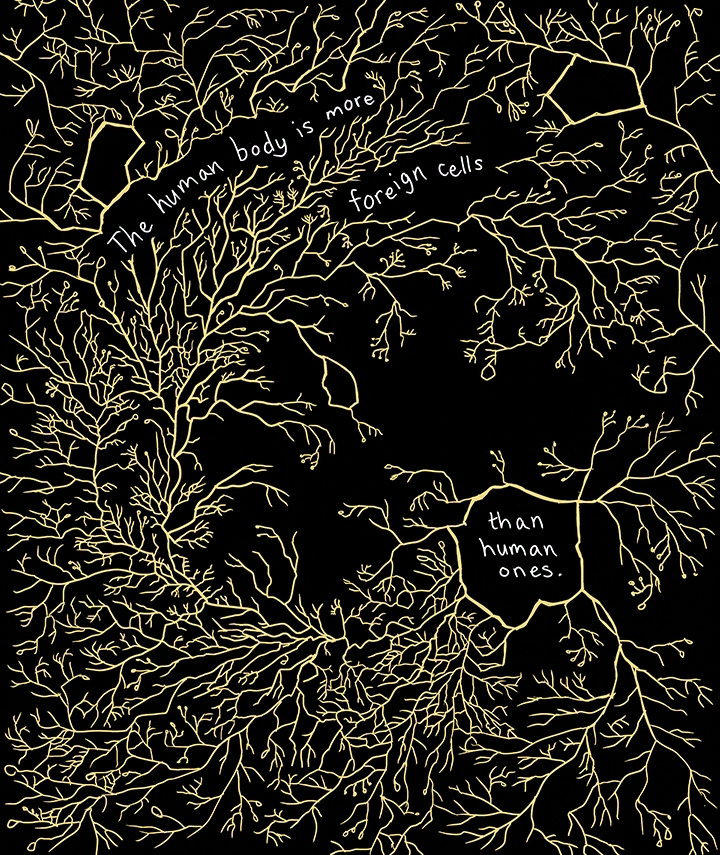
Page 1 The cover art of the branching slime mold lines is repeated on this page, gold on a black background. Handwritten white text interspersed in the negative space between the lines reads: “The human body is more foreign cells than human ones.”
Page 2 The background is black, and more root-like white lines creep across the page. They connect to a few irregular white blobs of varying sizes, which contain illustrations. Several of the smaller ones feature things you might expect to see under a microscope or in a biology textbook: amoebas, bacteria cells, mitochondria. The largest blob, in the upper left, contains a middle school age kid from the mid-torso up, with a mess of long wavy blonde hair and a backpack slung over one shoulder. The kid is wearing a slightly oversized sweatshirt and is clutching the backpack strap with one hand. The kid is looking askance at the reader, with a difficult to read expression that is somewhat flat. The blob that is lowest on the page, in the lower right corner, has little yellow mushrooms growing all over it – the only color on the page. White text loops through the negative space between the lines and drawings. Text reads: “Humans are around fifty-seven percent bacteria, viruses, archaea, and fungi.” The words “and fungi” are written in black and are contained within the blob that has mushrooms sprouting out of it, the overall effect emphasizing that part of the sentence.
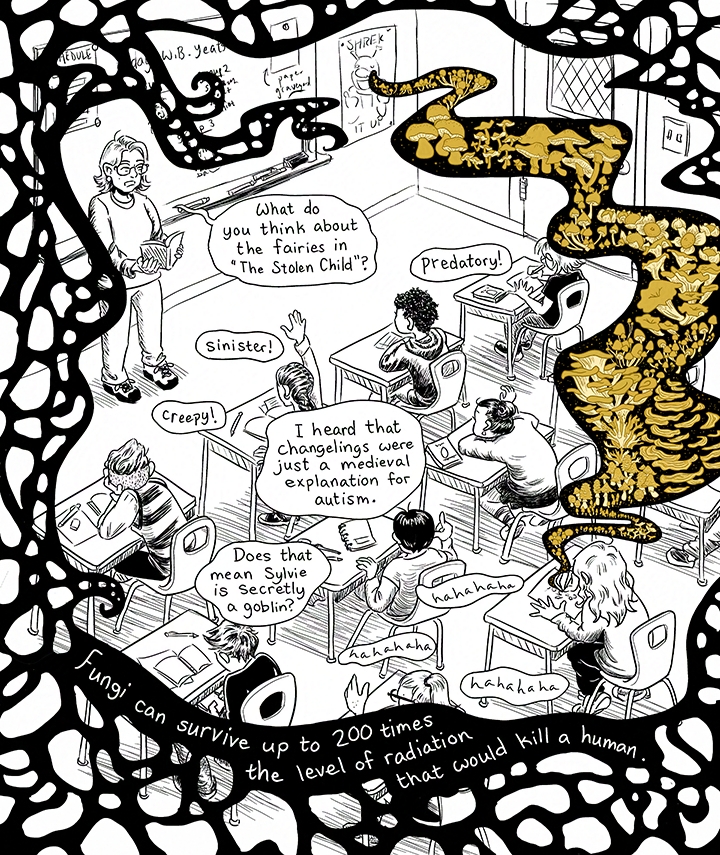
Page 3 An isometric perspective view of a middle school classroom. A teacher with glasses and sturdy tennis shoes stands at the front holding open a book. A whiteboard behind her has writing on it, mostly obscured, but the name W.B. Yeats is visible. Students sit at their desks, some engaged in the conversation and some less so. The long-haired kid from the previous page sits near the back, doodling frenetically. Rising from the page of doodles, in the shape of smoke or steam, is a black shape filled with a crowd of golden mushrooms of many different species. The whole page is framed by a similarly shaped black border that invades the classroom space, filled with transparent gaps similar in shape to the blobs from the previous page so the reader can see the classroom through it. Dialogue balloons are scattered around the page, indicating the conversation the teacher is having with the students. The teacher asks: “What do you think about the fairies in ‘The Stolen Child’?” Students shout out their answers: “Predatory!” “Sinister!” “Creepy!” “I heard that changelings were just a medieval explanation for autism.” “Does that mean Sylvie is secretly a goblin?” Students laugh at this last comment, and their laughter floats around the desk of the kid who is doodling mushrooms.
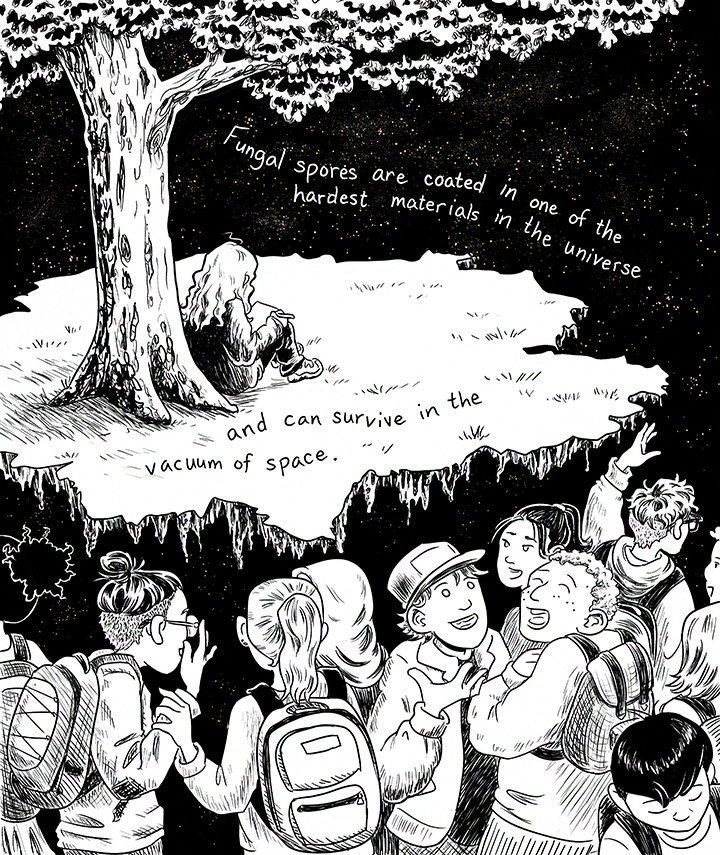
Page 4 The long-haired kid (Sylvie) sits alone under an oak tree, back to the reader and sketchbook resting on knees. The tree and the grass surrounding it form a little island which appears to be floating against a black background scattered with golden stars (or spores). In the foreground, middle schoolers mingle, many with backpacks on. Sylvie, sitting apart on the island in the background, seems very isolated and alone. White text undulates across the black background, reading: “Fungal spores are coated in one of the hardest materials in the universe” and the sentence continues in black text on the white of the grass below Sylvie and the tree: “and can survive in the vacuum of space.”
Page 5 The background is black, and white exhaust billowing up from the exhaust pipe of a school bus that rumbles along in the lower right corner forms the “panels” on this page. Several moments are illustrated in the fug of the exhaust: Sylvie taking a spiral notebook out of a locker, the notebook covered in stickers; Sylvie’s hands packing up a backpack, which has three pins on it (one with a genderqueer symbol, one with an infinity symbol for autism, one with the stripes of a pride flag); Sylvie putting headphones on over their ears; and Sylvie drawing in a sketchbook on their lap as they sit on a seat in the school bus. White text is interspersed through the negative space of the black background, reading: “Fungi don’t need light or gravity to grow.”
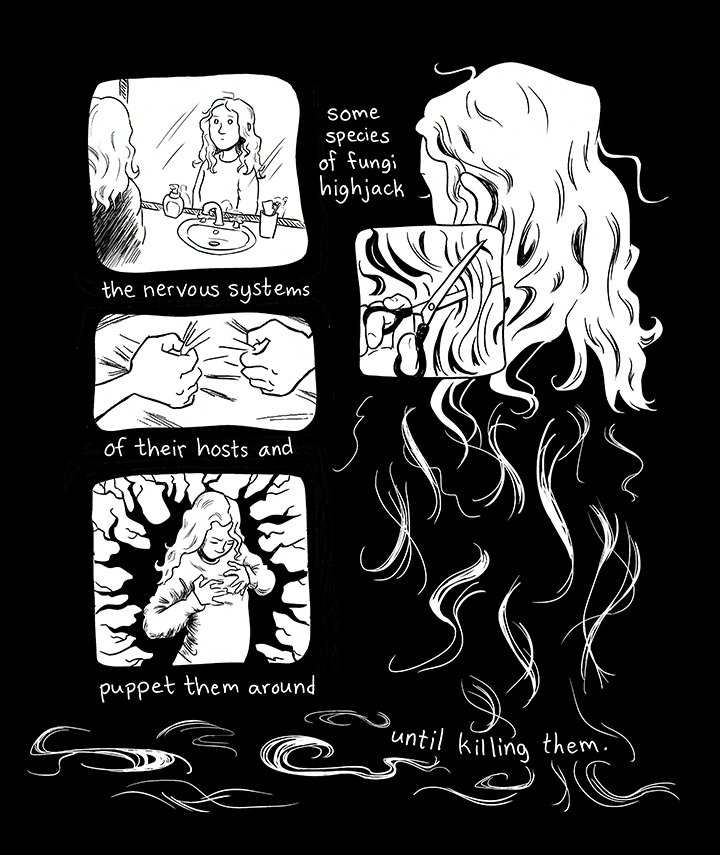
Page 6 The background is black, and on the left side of the page is a descending column of panels, irregularly shaped rounded rectangles. In the first panel, Sylvie stares into a bathroom mirror, reflection staring back. In the next panel, there is a closeup of hands clenching fabric. In the third panel, zoomed out, Sylvie is visible from the waist up, clawing at the fabric of their sweatshirt as they scowl in distress at their chest. Scraggly black lines emanate from a pool of black negative space behind them, implying mental anguish. In the negative space to the right of the three panels floats a three-quarters view from the back of Sylvie’s head, long hair twisting down the page. An inset panel shows a hand holding a pair of scissors as they cut a hank of hair. Strands of hair float down and puddle in the black space at the bottom of the page. White text progressing down the page reads: “Some species of fungi hijack the nervous systems of their hosts and puppet them around until killing them.”
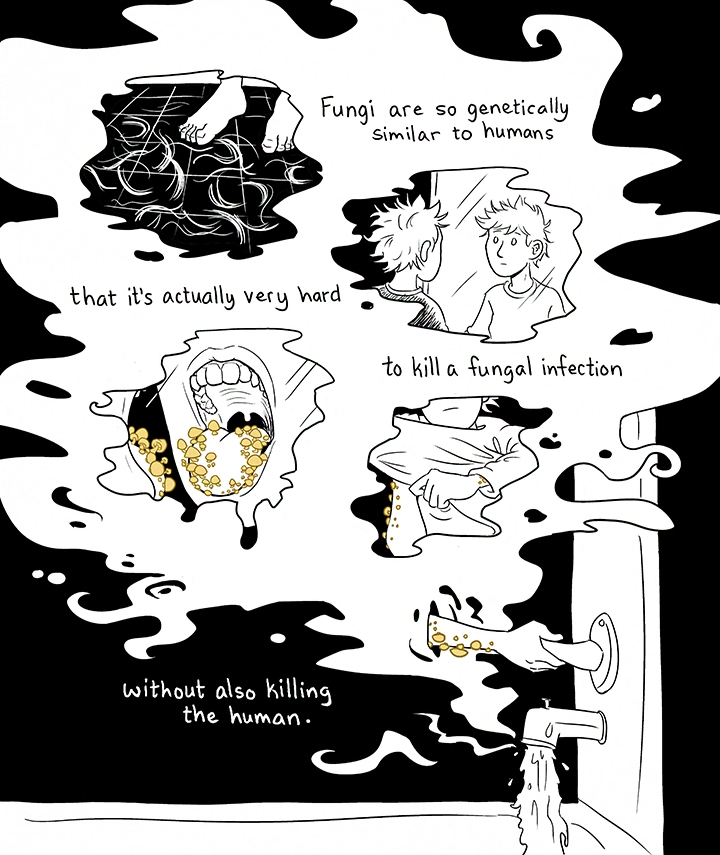
Page 7 Steam rises in a huge billowing cloud from the faucet of a bathtub/shower. In gaps in the steam, several moments are illustrated. In the first, bare feet stand on a tile floor that is strewn with strands of blonde hair. In the next, Sylvie looks at their reflection in the mirror, expression nearly identical to the one in the mirror panel on the previous page, but now their hair is short, sticking up unevenly all over their head. In the next image, we see a closeup of Sylvie’s open mouth reflected in the mirror. Dozens of small yellow mushrooms are growing out of their tongue, visible in both the reflection and the edge of their tongue in the foreground. In the next image, Sylvie pulls off their sweater, revealing yellow mushrooms sprouting along their arms. Sylvie’s arm, covered in mushrooms from the wrist up, reaches through the steam to turn on the faucet. Black lettering zigzags through the negative space of the steam, reading: “Fungi are so genetically similar to humans that it’s actually very hard to kill a fungal infection without also killing the human.” The last clause, “without also killing the human,” stands apart, in white text on the black background between the edge of the bathtub and the bottom of the steam cloud.
Page 8 Sylvie sits naked in the bathtub, steam rising up around them. Sylvie’s short hair sticks up untidily, and they are bent over with their arms crossed over their knees and their head down. The walls of the bathtub are covered in an overwhelming growth of golden shelf fungus. Round yellow mushrooms sprout from Sylvie’s back, shoulders, and arms. The bathwater is black. Black lettering encased in the rising steam reads: “Fungi are essential to the function of every ecosystem.”